Work / Featured build
DP-Evolution
I use synths every time I make music. I also wanted to build one of my own, so I did.
Where it started
It started in 1991 with a small ad in Loot, the classified paper. A Korg M1 was for sale, so I rang the number and arranged to meet the seller at Liverpool Street. Halfway through the call we realised we both worked at County NatWest, in the same building, one floor apart. About £300 changed hands and the M1 came home with me.
I've made music with hardware and software synths ever since, and that's what taught me how a filter should respond, what an envelope does to a sound and how an instrument should feel under your fingers.
Building my own
I still use my synths every time I make music. But I'd always wanted to build one myself, to understand what goes on inside one and to have an instrument that works exactly the way I think. So I set out to make my own from scratch, running in a web browser with nothing to install.
One feature at a time
There was never a master plan. I make music with it, and when I need something it doesn't do, I add it. When I wanted the arpeggiator to race over a slow beat, it got its own clock. When I wanted to record it into Logic, it got WAV export and routing into a DAW. When I wanted to play it from a real keyboard, it got MIDI. It still grows that way.
I used AI as a coding partner throughout, with one rule: read every addition until I understood it before moving on. When something broke, I found the line that caused it before asking for help. That's how I learned JavaScript.
Design decisions
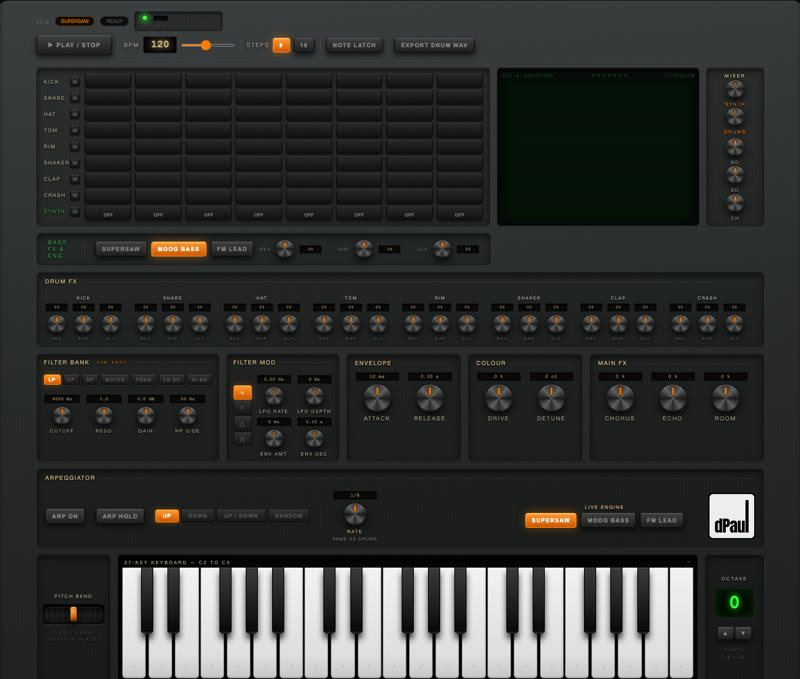
- Look like hardware on purpose. Musicians already know what a row of knobs and a step grid do, so the panel follows the signal path from left to right and top to bottom.
- Play instantly. Notes sound the moment you press a key, whether or not the pattern is running. I tried adding a sampler early on and took it back out, because loading files first got in the way of just playing.
- Keep sounds separate. The bass row runs its own engine and effects, so a distorted bassline can sit under a clean lead without either touching the other.
- Stay where you leave it. The pitch-bend ribbon holds its position instead of snapping back, so you can bend a note and keep it there.
What it does now
- Three synth engines (SuperSaw, Moog-style bass and FM lead) through a seven-mode filter bank with LFO, envelope and drive.
- A nine-track step sequencer with eight or sixteen steps, and reverb, delay and shape on every drum.
- A melodic bass row with its own engine and effects.
- An arpeggiator on its own clock, with nine rates from 1/1 to 1/32, triplets included.
- A 37-key on-screen keyboard, plug-and-play USB MIDI keyboards and a pitch-bend ribbon.
- WAV export, routing into Logic or Ableton, and a fifteen-section PDF manual.
Result
You can play DP-Evolution here, in its own page. It runs on desktop and laptop browsers, and works with a USB MIDI keyboard if you have one.
Work with me
Got a site, a tool or a video that needs making?
I take on freelance projects and I'm open to UX/UI and front-end roles. Tell me what you need.